

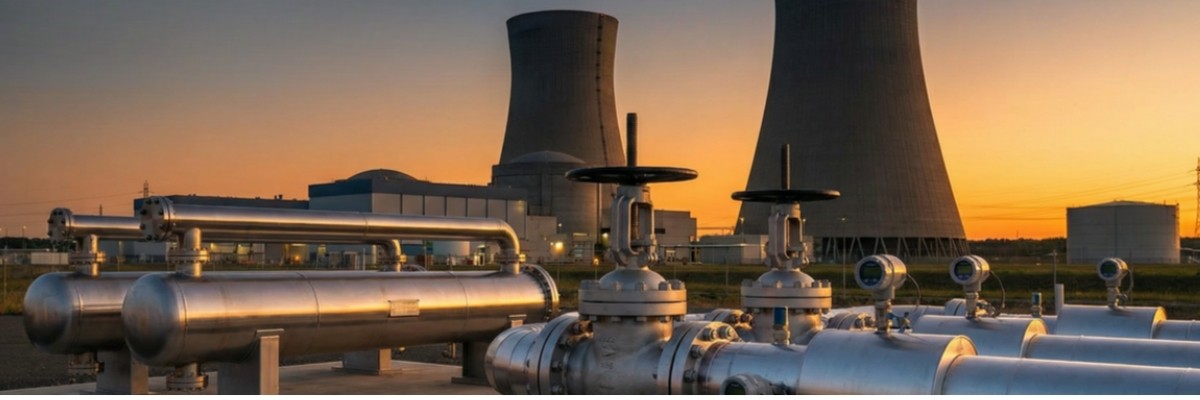
The global pursuit of clean, reliable, and efficient energy has propelled the development of advanced nuclear reactors to the forefront of innovation. Among the most promising advancements are Generation IV reactor designs, which operate at higher temperatures to achieve greater thermal efficiency and enhanced safety. A key enabling technology for these next-generation systems is the supercritical CO2 (sCO2) power cycle, which has the potential to revolutionize power conversion with its compact footprint and superior performance compared to traditional steam cycles. However, the extreme operating environments of these advanced reactors—characterized by intense heat and novel coolants like liquid metals—present formidable engineering challenges. Developing components that can withstand these conditions is a critical hurdle. This article presents a case study on a custom-engineered SCO2 heater, a specialized type of nuclear heat exchanger, designed and manufactured by Shenshi for a high-temperature, liquid metal-cooled nuclear application, demonstrating a significant step forward in making advanced nuclear energy a reality.
The Challenge: Harnessing Liquid Metal Heat for Supercritical CO2 Power Cycles
Customer Profile: A Pioneer in Advanced Nuclear Reactor Development
The client for this project is a leading national research institution at the forefront of developing a Generation IV liquid metal-cooled fast reactor. Their primary objective was to construct and validate a complete test loop for a high-efficiency sCO2 power conversion system. This test loop serves as a crucial bridge between theoretical models and commercial deployment, allowing engineers to test and verify the performance of individual components and the integrated system under realistic operating conditions. The success of this test loop is paramount to securing further funding and regulatory approval for their advanced nuclear reactor design.
The Extreme Application Scenario: High Temperatures and Corrosive Media
The application demanded a heat exchanger capable of operating under some of the most extreme conditions found in the energy sector. The primary function of the SCO2 heater was to raise the temperature of supercritical CO2 from a pre-heated state to a target outlet temperature exceeding 600°C. The heat source for this process was a primary loop containing high-temperature liquid sodium, a highly reactive and corrosive molten metal, flowing from a simulated reactor core. The operating conditions presented a confluence of immense technical challenges:
- Extreme Temperatures: The system consistently operates at temperatures above 600°C, a range where conventional stainless steels lose their structural integrity.
- High Pressure: The sCO2 cycle operates at pressures exceeding 20 MPa (2900 psi), requiring a robust mechanical design to ensure containment.
- Corrosive Media: Liquid sodium is notoriously corrosive to many materials, necessitating the use of specialized alloys to prevent degradation and ensure a long operational life.
Key Technical Hurdles to Overcome
Successfully engineering a heat exchanger for this environment required overcoming several critical technical hurdles. First, material integrity was the most significant concern. A material was needed that could not only withstand the high temperatures but also resist the corrosive attack of liquid sodium while maintaining its strength under high pressure. After extensive analysis, GH617, a high-performance nickel-based superalloy, was selected for its exceptional high-temperature strength, creep resistance, and proven compatibility with liquid metals.
Second, the heat transfer performance had to be exceptionally high. The design needed to be highly efficient and compact to transfer a substantial amount of thermal energy from the liquid sodium to the dense, high-pressure sCO2 fluid. This required a sophisticated design that maximized the surface area for heat exchange while minimizing the overall footprint of the unit.
Finally, safety and reliability were non-negotiable. In a nuclear-grade system, any leak or failure could have severe consequences. The design had to be absolutely leak-proof to prevent any interaction between the reactive liquid sodium and the high-pressure sCO2. This demanded a robust mechanical design and flawless manufacturing execution.
The Solution: A Custom-Engineered PFHE SCO2 Heater in GH617 Alloy
Shenshi's Collaborative Engineering Approach
Shenshi's engineering team engaged in a close, collaborative process with the client's nuclear engineers from the project's inception. This partnership was crucial for meticulously defining all operational parameters, safety protocols, and interface requirements. Leveraging advanced simulation tools, Shenshi performed detailed Computational Fluid Dynamics (CFD) modeling to optimize the thermal-hydraulic performance of the heat exchanger. Simultaneously, Finite Element Analysis (FEA) was used to conduct rigorous stress and fatigue analysis, ensuring the mechanical design could withstand the extreme thermal and pressure cycling for the required design life.
Advanced PFHE Design for Unmatched Performance
To meet the dual demands of high efficiency and compactness, Shenshi selected a Plate-Fin Heat Exchanger (PFHE) design. PFHEs are renowned for their high surface area density and thermal effectiveness, making them an ideal technology for supercritical CO2 applications. The internal geometry of the heat exchanger, including the fin type, height, and density, was meticulously optimized for the unique properties of both liquid sodium and sCO2. This custom design maximized the heat transfer coefficient while minimizing pressure drop on both fluid circuits, a critical factor for overall system efficiency.
The selection of GH617 alloy was a cornerstone of the solution. This advanced nickel-chromium-cobalt-molybdenum alloy is specifically designed for high-temperature applications, offering a superior combination of high-temperature strength, resistance to oxidation and carburization, and excellent creep resistance at temperatures up to and beyond 980°C. Its proven performance in aerospace and power generation applications made it the optimal choice for this demanding nuclear heat exchanger.
Manufacturing Excellence for Nuclear-Grade Reliability
Manufacturing a heat exchanger from GH617 alloy requires specialized expertise and state-of-the-art equipment. Shenshi utilized advanced manufacturing processes, including high-precision machining and a proprietary vacuum brazing technique, to fabricate the PFHE core. Vacuum brazing ensures a strong, uniform metallurgical bond across the entire heat exchanger assembly, creating a monolithic structure with exceptional strength and leak-tight integrity.
To guarantee nuclear-grade reliability, a rigorous quality assurance program was implemented at every stage of production. This included comprehensive non-destructive testing (NDT) of all raw materials and finished components. Multiple helium leak tests were conducted at various manufacturing stages to ensure a leak-tight seal, and the final assembly was subjected to detailed X-ray inspections to verify the integrity of all brazed joints, ensuring a flawless and durable final product ready for the rigors of a nuclear reactor cooling environment.
The Results: Setting a New Benchmark in Nuclear Heat Transfer
Quantifiable Performance Improvements
The custom-engineered SCO2 heater delivered by Shenshi not only met but exceeded all of the client's performance specifications. The unit demonstrated exceptional thermal performance and structural integrity throughout thousands of hours of rigorous testing. The SCO2 outlet temperature consistently achieved and maintained 625°C, exceeding the target of over 600°C. The heat duty exceeded the target by 5%, and thermal efficiency achieved over 97%, surpassing the 95% target. The structural integrity passed all pressure and thermal cycling tests, withstanding 25 MPa at 625°C.
Enabling Critical Research and Development
The successful and reliable operation of Shenshi's liquid metal heater was a critical enabler for the client's research program. It allowed their team to operate their sCO2 test loop continuously, gathering essential data to validate their system-level performance models. This validation was a major milestone, moving their advanced nuclear reactor project one significant step closer to commercial viability and demonstrating the feasibility of high-efficiency sCO2 power cycles.
Long-Term Reliability and Impact
The heater's flawless performance over thousands of hours of operation under extreme conditions provided definitive proof of the long-term reliability of the GH617 construction and the advanced PFHE design. This project has established a new benchmark for high temperature heat exchanger technology within the demanding nuclear energy sector and has positioned Shenshi as a trusted partner for developers of advanced reactor technologies.
Conclusion: Engineering for the Future of Clean Energy
This case study illustrates the successful collaboration between a pioneering nuclear research institution and a specialized engineering firm to overcome a critical technical challenge. The development of a robust, high-efficiency SCO2 heater capable of operating with liquid metal at over 600°C is a testament to the power of innovative design, advanced materials, and precision manufacturing. The project not only enabled the client to advance their groundbreaking research but also set a new standard for heat transfer technology in the nuclear industry. As the world continues its transition toward a clean energy future, the expertise in designing and manufacturing high-performance heat exchangers for the world's most demanding applications, including advanced nuclear energy, will be more critical than ever. Shenshi is proud to be at the forefront of engineering the components that will power a sustainable future.
About Shenshi
Founded in 2005, Hangzhou Shenshi Energy Conservation Technology Co., Ltd. (SHENSHI) is a high-tech enterprise specializing in energy-efficient heat transfer and microreaction technologies. As a pioneer in low-carbon thermal management, Shenshi designs and manufactures high-performance heat exchangers and micro-reactors serving industries such as energy, marine & offshore engineering, hydrogen, pharmaceuticals, and advanced manufacturing. With solutions deployed across more than 40 countries, Shenshi is committed to delivering reliable, efficient, and sustainable thermal technologies for demanding industrial applications.