
Continuous Flow Reactor Case Studies: Transforming Pharmaceutical Manufacturing
Overcoming Pharmaceutical Manufacturing Challenges with Continuous Flow Reactors: A Case Study Approach
The pharmaceutical industry is under constant pressure to improve production efficiency, enhance safety, and ensure the highest levels of product purity. Traditional batch processing, while deeply entrenched, often struggles to meet these modern demands, particularly when dealing with highly exothermic reactions or hazardous reagents. Enter the continuous flow reactor— a technology that is rapidly reshaping pharmaceutical manufacturing.
By transitioning from batch to continuous flow chemistry, companies are not only solving critical operational pain points but also unlocking new levels of productivity. This article delves into real-world case studies demonstrating how advanced tubular reactor systems address specific customer challenges and deliver compelling product advantages.
The Challenges of Traditional Batch Processing
For many pharmaceutical manufacturers, relying on conventional batch reactors presents several significant hurdles:
1. Safety Risks with Highly Exothermic Reactions: Reactions such as nitration and oxidation release massive amounts of heat. In a large batch vessel, controlling this temperature spike is challenging, increasing the risk of thermal runaway and potential safety incidents.
2. Inefficient Heat and Mass Transfer: The low surface-area-to-volume ratio in batch reactors leads to uneven mixing and poor heat dissipation. This often necessitates extended reaction times (e.g., slow dropwise addition of reagents) to maintain control.
3. Low Conversion Rates and Product Inconsistency: Inefficient mixing can result in low single-pass conversion rates, requiring extensive recycling of unreacted materials. This not only lowers overall productivity but can also lead to inconsistent product quality.
4. Handling Hazardous Materials: Processes involving highly reactive or toxic substances, such as fluorination reagents, pose significant exposure risks to operators and the environment when conducted in open or semi-open batch systems.
5. Large Footprint and High Energy Consumption: Traditional setups require massive equipment and substantial energy for heating and cooling large volumes of liquid, driving up operational costs.
Product Advantages of Advanced Tubular Reactor Systems
Modern tubular reactors, particularly those utilizing microchannel and helical structures, offer targeted solutions to these pain points:
• Exceptional Heat Exchange: The staggered, sawtooth-like helical design significantly increases the heat transfer area. With overall heat transfer coefficients reaching up to 3000 W/m²·°C, these systems can rapidly remove heat generated by exothermic reactions, ensuring precise temperature control.
• Intensified Mixing: The internal structure induces turbulence, ensuring rapid and homogeneous mixing of reactants. This leads to faster reaction kinetics and higher conversion rates.
• Enhanced Safety: Continuous flow systems operate with a very small hold-up volume (the amount of reacting material present at any one time). In the event of a malfunction, the potential hazard is drastically minimized. Furthermore, the fully enclosed nature of the system prevents the leakage of hazardous chemicals.
• Skid-Mounted Automation: Industrial-scale systems are often delivered as pre-assembled, skid-mounted units. This modular approach drastically reduces on-site installation time and footprint. Integrated with Distributed Control Systems (DCS), they enable fully automated, real-time monitoring and control.
Real-World Case Studies: Transforming Pharmaceutical Production
The theoretical benefits of continuous flow reactors translate into remarkable real-world results. Here are specific examples of how these systems have solved critical challenges for pharmaceutical clients.
Case Study 1: Revolutionizing an Oxidation Process
The Challenge: A pharmaceutical company was producing a key innovative drug using a traditional batch oxidation process with hydrogen peroxide. The reaction was highly exothermic, requiring a lengthy 60-minute dropwise addition of reagents to manage the heat. The single-pass conversion rate was a mere 10%, necessitating extensive material recovery. Furthermore, the process consumed massive amounts of chilled brine (20 tons/hour) and struggled to maintain consistent product quality.
The Solution: The manufacturer upgraded to a continuous flow system. The fast, highly exothermic peroxide generation step was transitioned to a tubular reactor, allowing for instantaneous heat removal. The slower rearrangement step was kept in a batch reactor for optimal "ripening." The entire process was upgraded with DCS and automated safety systems (SIS, GDS).
The Results:
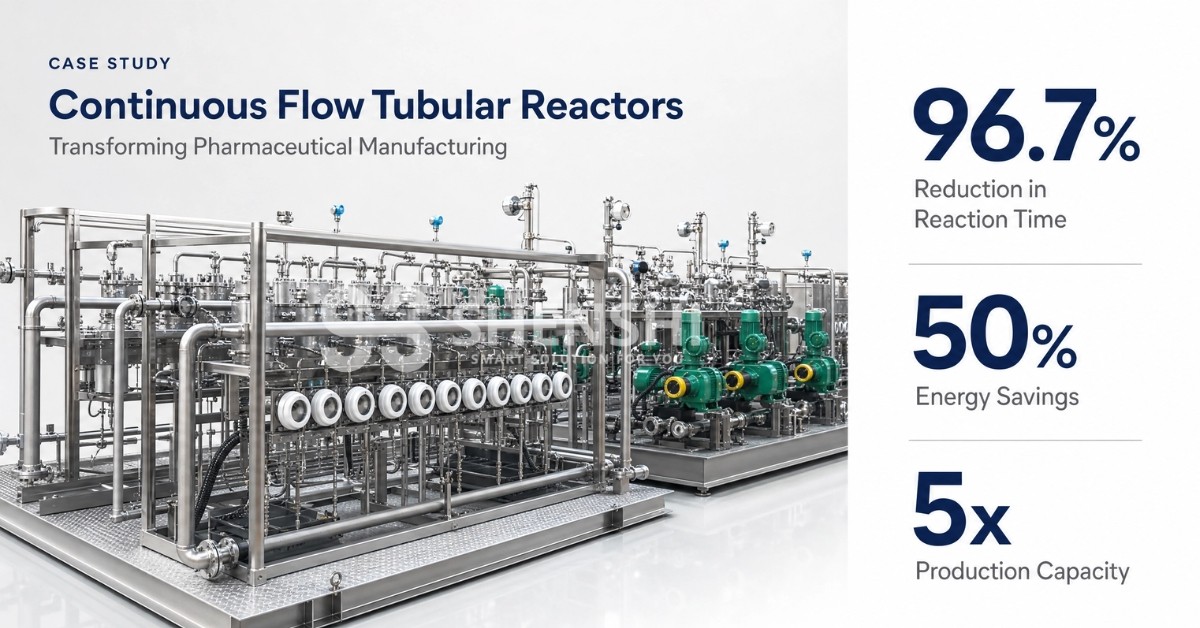
• Reaction Time Slashed: The oxidation time was reduced from 60 minutes to just 2 minutes—a staggering 96.7% decrease. The ripening time was cut from 4 hours to 1 hour.
• Energy Savings: The consumption of chilled brine plummeted from 20 tons/hour to 4 tons/hour, representing a 50% reduction in energy usage.
• Quality Improvement: Product purity increased significantly, reaching 99.5%.
Case Study 2: Safe and Efficient Fluorination
The Challenge: A client was utilizing a batch process for a fluorination reagent. The low operating temperatures and poor material stability created significant leakage risks. Additionally, the fast, exothermic nature of the reaction meant that the intermittent batch process suffered from severely low production capacity.
The Solution: The implementation of a combined microchannel and tubular reactor system provided a fully enclosed, continuous process capable of handling a 10,000-ton annual throughput. The skid-mounted design allowed for rapid deployment.
The Results:
• Rapid Deployment: The entire project, from design to production, was completed and commissioned in just 4 months.
• Massive Capacity Boost: Production capacity increased by 500% (a 5-fold improvement).
• Yield Enhancement: The overall product yield improved by 2 to 5 percentage points, while completely eliminating the risk of hazardous reagent leakage.
Case Study 3: Scaling Up Nitration Reactions
Nitration is notoriously hazardous due to the highly reactive nature of nitric acid and the massive heat generated. A review of multiple successful deployments demonstrates the scalability and reliability of continuous flow systems in this demanding application.
For instance, a major pharmaceutical company successfully implemented a system comprising 40 microchannel reactors (utilizing both Hastelloy C-276 and Silicon Carbide) combined with multiple tubular reactors to achieve a 1,000-ton annual capacity for isopropanol nitration. In another case, a technology firm utilized a parallel setup of 500ml Silicon Carbide reactors and tubular reactors to safely manage an impressive 17,000-ton annual throughput for a complex chloromethylbenzenesulfonic acid nitration process.
Conclusion
The evidence is clear: for pharmaceutical manufacturing, the transition to continuous flow chemistry using advanced tubular reactors is not just an operational upgrade; it is a strategic necessity. By addressing the fundamental pain points of safety, efficiency, and scalability inherent in batch processing, these systems empower manufacturers to produce higher quality drugs faster, safer, and more sustainably. As the industry continues to prioritize continuous manufacturing, the adoption of these innovative reactor technologies will be a defining factor in future success.