
Copper vs Stainless Steel Heat Exchangers: Which is Better?
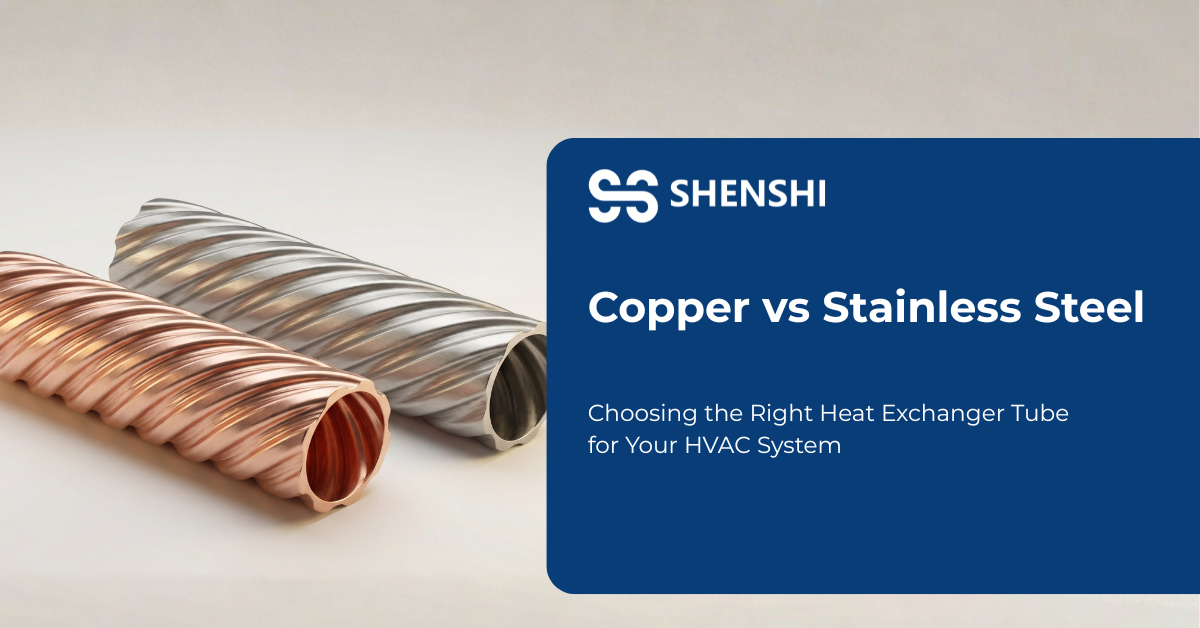
HVAC Cost-Efficiency Guide: Copper vs Stainless Steel Heat Exchanger Tube
In the HVAC and refrigeration industry, selecting the right material for heat exchanger inner tubes is one of the most consequential decisions a manufacturer or engineer can make. The choice directly affects system performance, operational lifespan, maintenance frequency, and overall production cost. Two materials dominate this decision-making process: copper and stainless steel.
With global copper prices subject to significant market volatility and growing demand for cost-efficient manufacturing solutions, the conversation around copper vs stainless steel heat exchanger tubes has never been more relevant. This article provides an objective, data-driven comparison to help you evaluate which material best suits your specific application.
1. Thermal Conductivity: Where Copper Leads
When it comes to raw thermal performance, copper is the undisputed benchmark in the HVAC industry. The thermal conductivity of copper (approximately 400 W/m·K) is significantly higher than that of stainless steel (approximately 16 W/m·K for 316L grade). This means copper tubes can transfer heat far more rapidly, making them ideal for compact systems where maximizing thermal efficiency within a limited footprint is the primary objective.
However, this performance gap is not insurmountable for stainless steel. Modern manufacturing techniques, such as multi-head spiral corrugated tube designs, can significantly increase the internal surface area and promote fluid turbulence within the tube. This design optimization effectively improves the overall heat transfer coefficient of stainless steel heat exchangers, allowing them to meet demanding performance requirements in many HVAC applications.
2. Corrosion Resistance: A Nuanced Comparison
Corrosion resistance is a critical factor that determines the long-term reliability of any heat exchanger. Both materials have distinct strengths and vulnerabilities:
| Property | Copper (TP2) | Stainless Steel (316L) |
|---|---|---|
| General Corrosion Resistance | Good | Excellent |
| Oxidation Resistance | Moderate (forms patina) | Excellent (passive oxide layer) |
| Scaling Resistance | Lower | Higher |
| Chloride Ion Sensitivity | Lower | Higher (risk of pitting) |
| Long-term Heat Transfer Stability | Degrades with oxidation | Stable with minimal scaling |
Stainless steel, particularly 316L grade, contains chromium and nickel that form a dense, self-healing passive oxide layer on the surface. This layer provides exceptional resistance to oxidation, acids, alkalis, and salt-based corrosive media. In contrast, copper tubes are susceptible to forming a "patina" (copper green) over time, which acts as a thermal insulator and gradually reduces heat transfer efficiency.
A critical consideration: While stainless steel excels in general corrosion resistance, it is highly sensitive to chloride ions in water. In operating environments where the chloride ion concentration exceeds 80 mg/L, stainless steel is prone to pitting corrosion and stress corrosion cracking. In such scenarios, copper may remain the more reliable choice. Strict water quality management (pH > 7.5, chloride < 80 mg/L) is essential when deploying stainless steel heat exchangers.
3. Mechanical Strength and Structural Advantages
Stainless steel demonstrates superior mechanical strength, toughness, and resistance to impact and vibration compared to copper. This structural robustness translates into several practical advantages for heat exchanger design:
Because of its higher tensile strength, stainless steel tubes can be manufactured with thinner wall thicknesses while maintaining equivalent pressure ratings. This reduction in material volume can contribute to lighter system weights and more compact designs. Furthermore, the smooth, hard surface of stainless steel significantly reduces the rate of scaling and fouling. Without the accumulation of scale deposits, stainless steel heat exchangers maintain stable heat transfer performance over extended operational periods, leading to lower maintenance costs and reduced system downtime.
Copper, being a softer metal, is more susceptible to erosion, mechanical damage, and scaling. Copper heat exchanger designs also typically require a larger corrosion allowance in wall thickness, adding to the overall material consumption.
4. Cost-Efficiency and Material Price Stability
The economic dimension of material selection is increasingly important in today's competitive manufacturing environment. Copper is a finite, globally traded commodity, and its market price is subject to significant volatility driven by mining output, geopolitical factors, and industrial demand. This price instability can create challenges for manufacturers trying to maintain consistent production costs.
Stainless steel, by contrast, offers a more stable and generally lower raw material cost. For production facilities seeking a budget-saving alternative that does not compromise on overall system reliability, stainless steel presents a compelling value proposition. It is worth noting, however, that the higher hardness of stainless steel and its specialized welding requirements (argon arc or laser welding) can increase fabrication costs. A comprehensive total-cost-of-ownership analysis—factoring in material cost, processing cost, maintenance frequency, and operational lifespan—is therefore essential when making the final material selection.
5. Processing and Manufacturing Considerations
The ease of fabrication is another dimension where copper and stainless steel differ significantly:
Copper is a highly workable material. It can be easily bent, expanded, and brazed using conventional equipment. This simplicity of fabrication contributes to lower processing costs and shorter production cycles.
Stainless steel presents greater manufacturing challenges. Its high hardness requires specialized bending equipment and matched tooling. Welding stainless steel demands advanced techniques such as argon arc or laser welding, which increases process complexity and cost. Additionally, the heat-affected zones near welds can become structural weak points, particularly at connection joints and maximum bend radii, if not handled with precision. Proper quality control—including 100% helium leak testing—is essential to ensure the integrity of stainless steel heat exchanger assemblies.
Conclusion: Choosing the Right Material for Your Application
The comparison between copper and stainless steel heat exchanger tubes is not a matter of one material being universally superior to the other. Both materials have well-defined strengths that make them optimal for different scenarios:
Choose Copper when:
- Maximum thermal conductivity in a compact space is the primary requirement.
- The operating water has high chloride ion concentrations that cannot be controlled.
- Ease of fabrication and lower processing costs are critical priorities.
Choose Stainless Steel when:
- You are seeking a cost-effective, budget-saving material alternative for your production.
- The system requires high mechanical strength, superior scaling resistance, and long-term stability.
- Water quality can be managed within the recommended parameters (chloride < 80 mg/L, pH > 7.5).
- Reducing long-term maintenance costs and extending system lifespan are key objectives.
As a manufacturer, we recognize that different projects have different requirements. That is why we offer both copper and stainless steel heat exchanger solutions, allowing our customers to select the option that best aligns with their performance goals and cost-efficiency strategies.
About Shenshi
Founded in 2005, Hangzhou Shenshi Energy Conservation Technology Co., Ltd. (SHENSHI) is a high-tech enterprise specializing in energy-efficient heat transfer and microreaction technologies. As a pioneer in low-carbon thermal management, Shenshi designs and manufactures high-performance heat exchangers and micro-reactors serving industries such as energy, marine & offshore engineering, hydrogen, pharmaceuticals, and advanced manufacturing.
With solutions deployed across more than 40 countries, Shenshi is committed to delivering reliable, efficient, and sustainable thermal technologies for demanding industrial applications.