Nuclear Reactor Integrated Prototype Mounted on Trucks! Technical Progress of “Nuclear Power Pack” and PCHE Adaptation Potential

Nuclear Reactor Integrated Prototype Mounted on Trucks! Technical Progress of “Nuclear Power Pack” and PCHE Adaptation Potential
Preface
Vehicle-mounted mobile nuclear energy integrates a microreactor, radiation shielding, heat exchange and safety control systems into a container-scale mobile carrier transported by heavy-duty trucks. It supplies power for off-grid scenarios such as remote islands, border outposts, emergency disaster relief, remote mining areas and field computing centres. The “Nuclear Power Pack” is a specific device under this technical route, representing the application concept combining micro nuclear reactors with mobile transport carriers.
In 2020, a national key R&D programme launched a special project for vehicle-mounted mobile megawatt-class micro nuclear power supplies, supporting continuous research on heat pipe, lead-bismuth and high-temperature gas-cooled routes, alongside supporting studies including vehicle-mounted microreactor integration and lightweight shielding. By 2026, the 10 MWt lead-bismuth “Nuclear Power Pack” has completed integrated simulation tests. The prototype measures approximately 6.1 m × 2.6 m × 2.6 m and weighs around 28 tonnes, and remains in the testing and verification phase. Prototype integration and truck loading demonstrations have been realised, while public road transportation is still pending full-vehicle safety validation and regulatory approval. Truck loading demonstration marks a milestone in engineering development, yet commercial road deployment is still ahead. Thermal integration is a critical link in this journey, and also the entry point for PCHE in discussions on vehicle-mounted nuclear energy.
I. Lead-Bismuth Route Enables Miniaturisation of the Nuclear Power Pack
Conventional pressurised water reactors use pressurised water as coolant, requiring high-pressure primary coolant systems to maintain water in liquid state at elevated temperatures. Pressure vessels and concrete containment structures constitute fixed infrastructure that cannot be downsized.
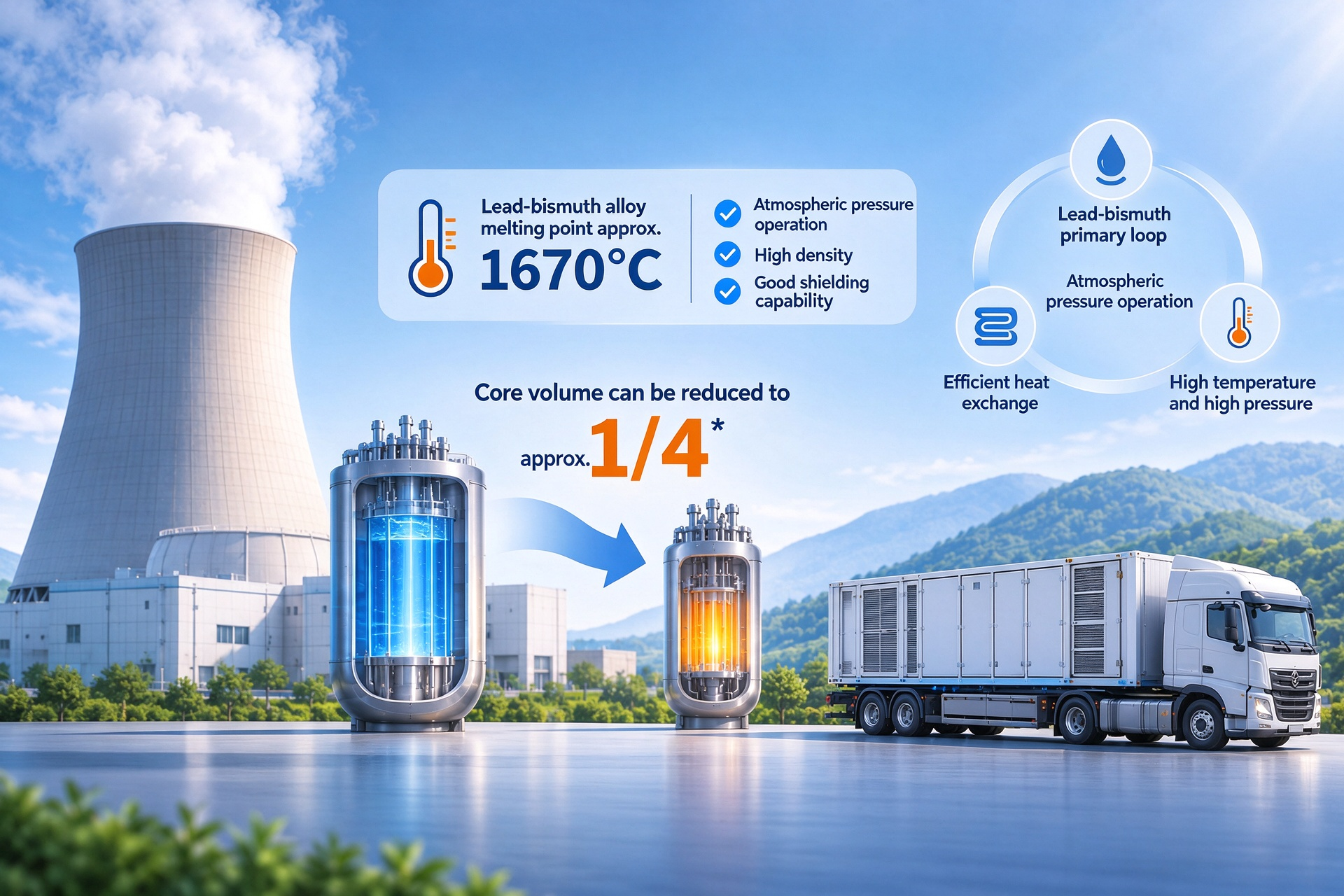
Lead-bismuth eutectic alloy has a boiling point of roughly 1670 °C and low vapour pressure, remaining liquid under near-atmospheric pressure. This eliminates the need for high-pressure vessels and most containment structures. Featuring high density and high atomic number, lead-bismuth alloy provides effective gamma-ray shielding. Under specific power ratings and design conditions, the publicly reported 10 MWt design enables the core volume to be reduced to around one quarter of that of a pressurised water reactor. This ratio is not a universal property of lead-bismuth reactors, but it demonstrates that the system can fit into a container footprint.
Core downsizing solves the containerisation challenge, while road deployment hinges on thermal system integration and full-vehicle qualification. The primary lead-bismuth loop operates near atmospheric pressure, yet high-pressure segments still exist within the thermal system. The lead-bismuth reactor generates heat for power conversion; for vehicle-mounted systems demanding compact power conversion, the supercritical CO₂ Brayton cycle stands out for its high power density and compact turbomachinery.
When coupling a lead-bismuth reactor with an sCO₂ cycle, the secondary-side CO₂ operates at high pressure, creating a large pressure differential across the lead-bismuth/sCO₂ heat transfer interface. Achieving efficient heat transfer within limited space while meeting structural requirements under high temperature and large pressure differentials is a major engineering challenge for this route. The lead-bismuth–sCO₂ heat exchange interface becomes the core node of thermal integration, where PCHE emerges as a candidate heat exchanger solution.
II. PCHE Adaptation Logic: Compact Structure and Differentiated Channel Design
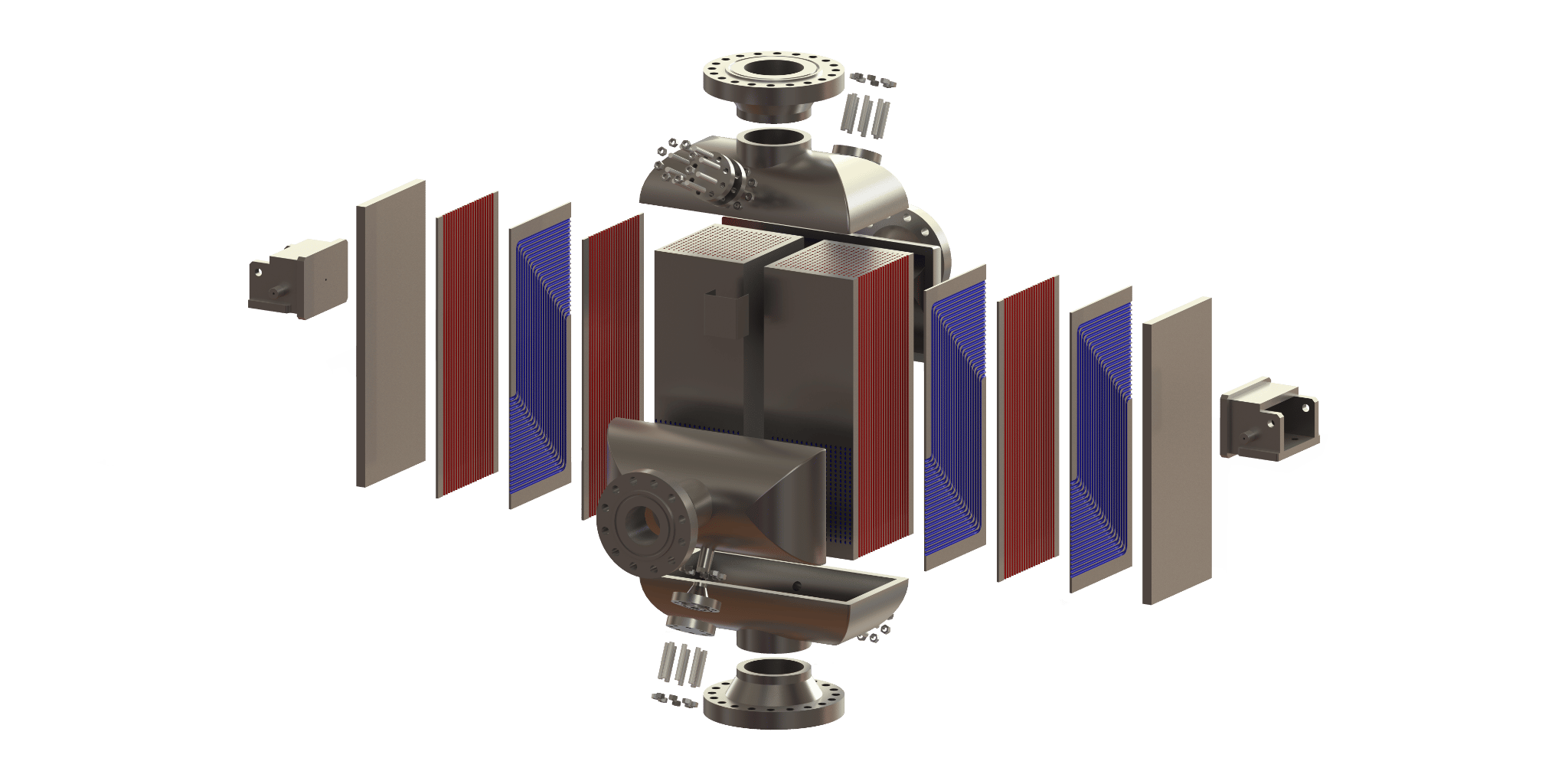
Printed Circuit Heat Exchangers (PCHE) adopt chemically etched microchannels and diffusion-bonded plates to form an integrated core. They deliver high heat transfer area per unit volume, compact footprint and robust pressure resistance. For lead-bismuth cooled reactors coupled to the sCO₂ Brayton cycle, PCHE is one of the promising intermediate heat exchanger candidates with solid research foundations and engineering adaptability.

The lead-bismuth side runs near atmospheric pressure while the sCO₂ side operates at high pressure, creating a substantial cross-wall pressure difference. PCHE cores are fabricated by chemically etching microchannels and diffusion-bonding metal plates into a single block. The monolithic design reduces internal mechanical joints, offering high compactness and pressure-bearing capacity, ideal for high-temperature, large-differential-pressure heat exchange scenarios.
The diffusion-bonded core combined with headers forms an identifiable, inspectable pressure boundary. Component-level integrity records can be incorporated into the full-vehicle safety dossier. For vehicle-mounted safety justification, this makes PCHE not merely a compact heat exchanger, but a heat exchanger with traceable pressure boundary integrity.
 2. Differentiated channel design balancing heat
transfer and flow resistance
For the distinct thermal requirements of lead-bismuth and sCO₂ sides, differentiated channel combinations can be explored: for instance, straight channels on the lead-bismuth side to control pressure drop, and zigzag enhanced channels on the sCO₂ side to improve heat transfer. Independent design for each side enables targeted trade-off between heat transfer efficiency and flow resistance, enhancing adaptability under complex thermal conditions.
3. High heat transfer density freeing up space for vehicle integration
Vehicle-mounted nuclear energy imposes strict constraints on equipment volume and weight. The compactness of heat exchange systems directly shapes the overall integrated design. Thanks to microchannel architecture, PCHE accommodates large heat transfer area within a small footprint to realise high heat duty exchange. Its compact form saves space occupied by heat exchange equipment, creating margins for system integration and weight control of the vehicle-mounted nuclear power unit.
III. Barriers for the Nuclear Power Pack from Test Sites to Public Highways
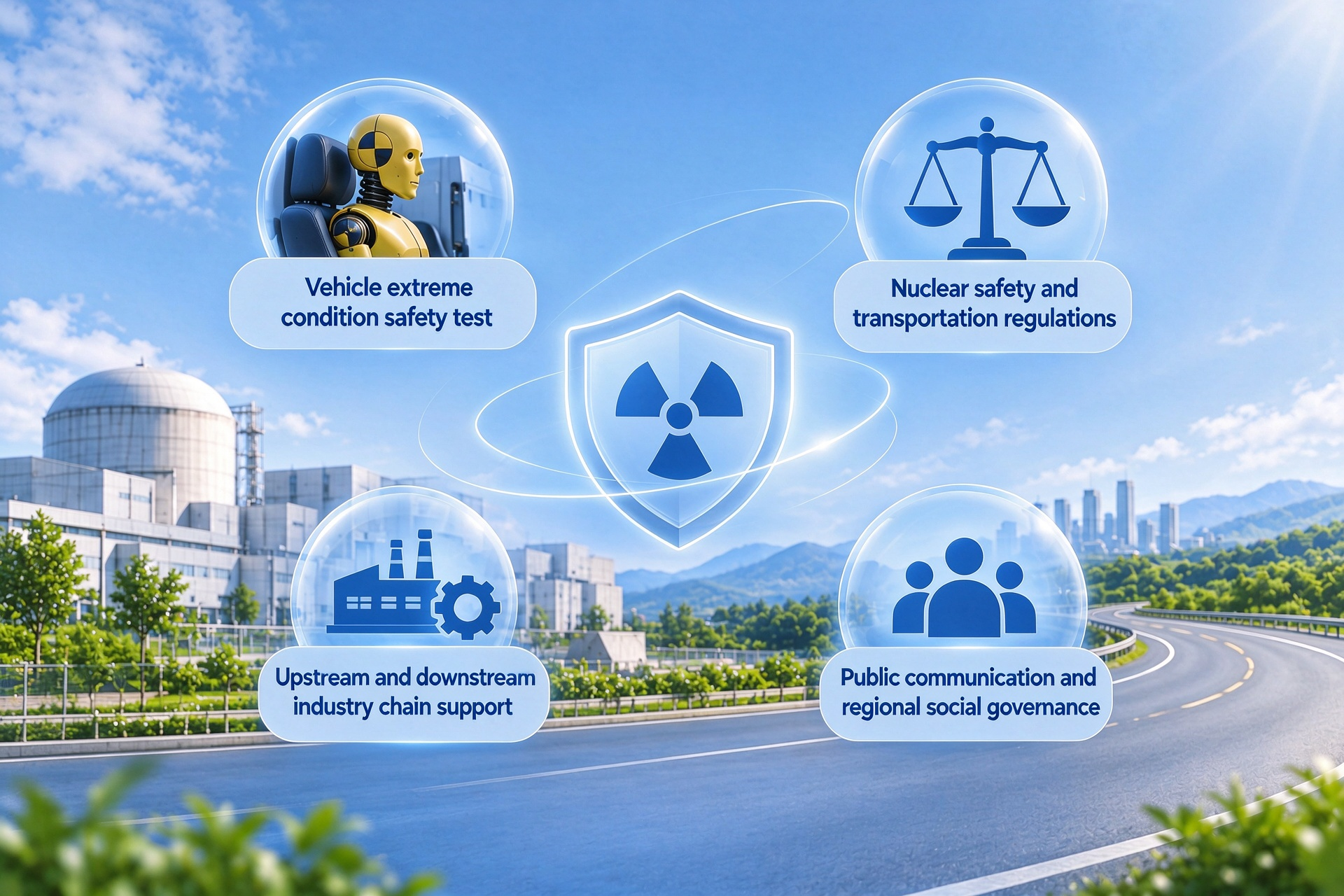
(1) Full-vehicle Extreme Condition Safety Tests
Completion of the integrated prototype enables system commissioning prior to truck loading, yet road transport safety qualification requires a separate validation suite: full testing including 50–80 km/h crash, overturning, external fire, high-low temperature vibration fatigue and flood immersion, to verify core containment integrity and zero radioactive release under accident conditions. Current domestic and international prototypes have only undergone static seismic bench tests, and the full validation campaign takes roughly 2–3 years.
(2) Nuclear Safety and Transportation Regulations
Oversight frameworks for small reactors are emerging: the National Nuclear Safety Administration issued the Technical Opinions on Nuclear Safety Supervision of Small Nuclear Power Reactors (Document No. 2026-145) in August 2026, applicable to land-based stationary small nuclear power reactors, prototype reactors and pilot reactors. Moored floating small nuclear reactors can follow the provisions by reference. However, special rules for highway transportation of mobile microreactors, transport classification of integrated reactors and cross-regional transit approval procedures remain incomplete. Rule drafting to implementation takes 3–5 years, constituting one major timeline constraint for commercial deployment.
(3) Upstream and Downstream Industrial Chain Support
Dedicated mass-production lines for long-cycle low-enrichment fuel, nationwide temporary storage and transfer stations for spent fuel from mobile reactors, and a standardised training system for operation and maintenance personnel must be established. A mature full industrial chain requires at least 4 years. For lead-bismuth coolant corrosion on structural materials under high temperature, high flow velocity and neutron irradiation, engineering solutions combining corrosion-resistant materials and oxygen control are available, while long-term operational field data still needs accumulation via demonstration projects.
(4) Public Communication and Regional Social Governance
Vehicle-mounted nuclear installations pass through villages and residential zones. Mechanisms including real-time radiation disclosure along transit routes, routine public outreach and multi-level emergency response coordination must be established. Public opinion assessment and social risk evaluation for site deployment cannot be compressed. Public communication is not a one-off science popularisation activity, but a governance process running through siting, transportation, operation and decommissioning.
IV. Phased Deployment Outlook of the Nuclear Power Pack
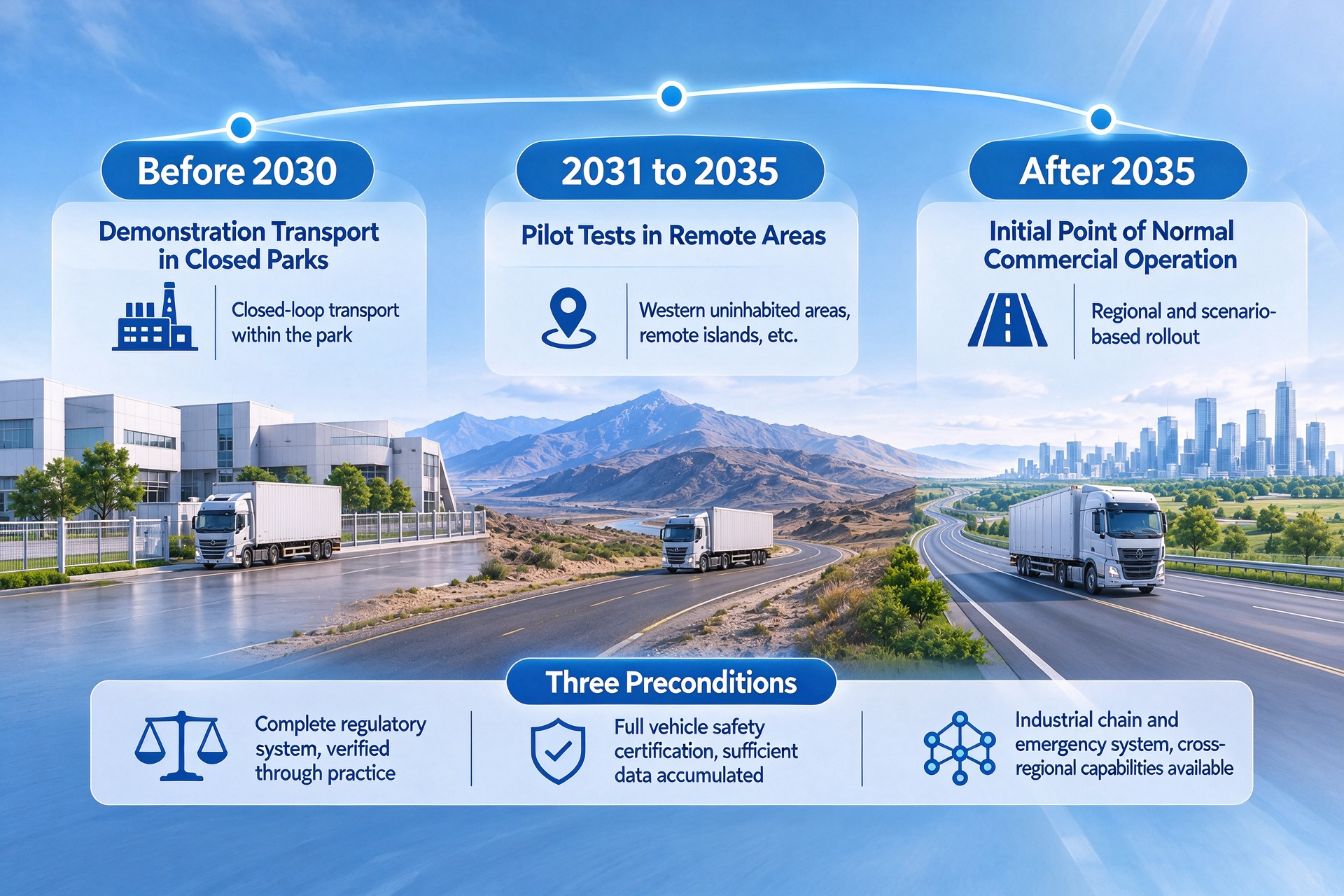
(1) Before 2030: Demonstration Transit within Closed Compounds
Full-vehicle extreme-condition safety validation will be completed between 2027 and 2028; interim regulatory trial rules for mobile microreactors will be released before 2029. Restricted short-distance vehicle transit demonstrations will be carried out on designated isolated test roads on islands and remote western mining zones. Before 2030, transit is limited to closed-loop movement within fenced sites, with access to public roads prohibited.
(2) 2031–2035: Licensed Pilot Operations in Remote Zones
A complete regulatory framework will take effect alongside nationwide multi-scenario environmental risk assessment. Licensed highway transport will be approved for uninhabited western regions, remote islands and enclosed large mining sites, with dedicated routes, restricted time windows, continuous radiation monitoring and dedicated security. Small-scale commercial power supply pilots will be launched. Access is limited to sparsely populated remote areas; urban roads with dense populations remain off-limits.
(3) Post-2035: Earliest Window for Routine Commercialisation
Routine commercial operation on general public roads nationwide will not start earlier than 2035, conditional on three prerequisites being satisfied simultaneously: a mature regulatory framework validated and revised by operational experience; sufficient full-vehicle safety data accumulated across multiple vehicle types and routes; and industrial and emergency systems capable of cross-provincial coordination. Even with all conditions met, rollout will proceed gradually by region and scenario. Deployment will start with closed or semi-closed applications such as emergency disaster relief, remote computing hubs and long-term power supply for border outposts, before expanding to general commercial transport.
About Shenshi
Founded in 2005, Hangzhou Shenshi Energy Conservation Technology Co., Ltd. (SHENSHI) is a high-tech enterprise specializing in energy-efficient heat transfer and microreaction technologies. As a pioneer in low-carbon thermal management, Shenshi designs and manufactures high-performance heat exchangers serving industries such as energy, marine & offshore engineering, and hydrogen.