
Why 316L Stainless Steel Inner Tubes Are Changing HVAC Design
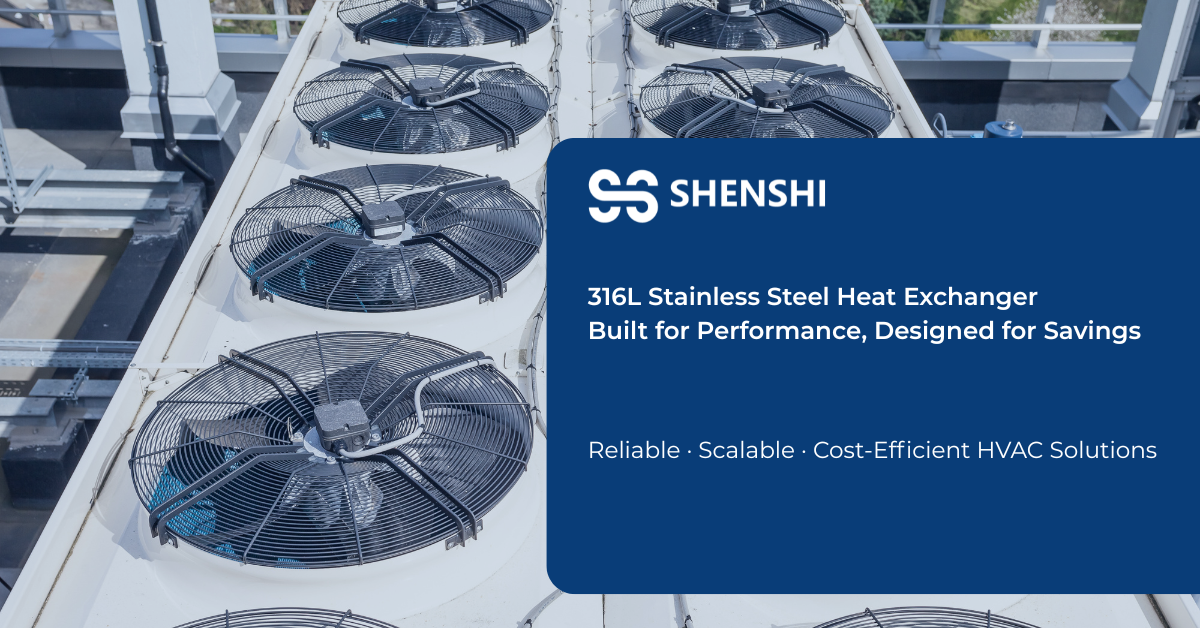
316L Stainless Steel Inner Tube Heat Exchangers: Performance, Reliability, and Cost Savings for HVAC Systems
As HVAC manufacturers and system designers navigate an increasingly cost-sensitive market, the question of heat exchanger tube material selection has become a central topic of engineering discussion. The traditional reliance on copper tubes is being re-examined in light of rising raw material costs, evolving system design capabilities, and the growing availability of high-quality stainless steel alternatives.
This article takes a deep dive into 316L stainless steel inner tube heat exchangers, examining their performance characteristics, reliability considerations, and cost-saving potential—while also acknowledging the continued strengths of copper in specific applications.
1. Understanding the Material Landscape
Before comparing materials, it is important to understand the physical and chemical properties that define their performance in heat exchanger applications.
Copper (TP2 Grade) has been the industry standard for decades. Its exceptional thermal conductivity, ease of fabrication, and reliable performance in a wide range of environments have made it the default choice for HVAC heat exchangers. However, copper is a finite resource, and its market price is subject to volatility based on global supply and demand.
Stainless Steel (316L Grade) is an austenitic stainless steel alloy containing chromium, nickel, and molybdenum. The addition of molybdenum significantly enhances its resistance to pitting and crevice corrosion compared to standard 304 stainless steel. While its thermal conductivity is lower than copper, its superior mechanical strength, corrosion resistance, and lower material cost make it an increasingly attractive option for HVAC applications.
2. Key Performance Comparison
The following table summarizes the key performance differences between copper (TP2) and 316L stainless steel in heat exchanger applications:
| Performance Dimension | Copper (TP2) | 316L Stainless Steel |
|---|---|---|
| Thermal Conductivity | ~400 W/m·K (Excellent) | ~16 W/m·K (Lower) |
| Corrosion Resistance (General) | Good | Excellent |
| Chloride Ion Sensitivity | Low | High (pitting risk) |
| Mechanical Strength | Moderate | High |
| Scaling / Fouling Resistance | Lower | Higher |
| Wall Thickness Requirement | Larger (corrosion allowance) | Thinner (high strength) |
| Material Cost Stability | Volatile (commodity market) | More stable |
| Raw Material Cost | Higher | Lower |
| Fabrication Complexity | Lower | Higher |
| Welding Requirements | Standard brazing | Argon arc / Laser welding |
This comparison illustrates that neither material is universally superior. The optimal choice depends on the specific operating environment, system design requirements, and budget constraints.
3. The Case for Stainless Steel: Advantages in HVAC Applications
3.1 Superior Corrosion and Scaling Resistance
One of the most compelling arguments for stainless steel in HVAC heat exchangers is its resistance to scaling and oxidation. In copper heat exchangers, the formation of an oxidation layer ("patina") on the inner tube surface acts as a thermal insulator, progressively degrading heat transfer efficiency over time. The accumulation of scale deposits further compounds this problem, requiring regular maintenance to restore performance.
Stainless steel's smooth, hard surface significantly inhibits scale formation. Combined with the passive oxide layer formed by its chromium-nickel composition, stainless steel heat exchangers can maintain stable heat transfer performance over extended operational periods with minimal maintenance intervention. This translates directly into lower lifecycle costs and reduced system downtime.
3.2 High Mechanical Strength and Thinner Wall Design
The superior tensile strength of 316L stainless steel allows for the design of heat exchanger tubes with thinner wall thicknesses while maintaining equivalent or superior pressure resistance compared to copper. This has several practical benefits: reduced material consumption per unit, lighter overall system weight, and the potential for more compact heat exchanger designs.
Furthermore, stainless steel's resistance to impact and vibration makes it well-suited for demanding industrial environments where mechanical stress is a concern.
3.3 Cost-Efficiency and Budget-Saving Potential
For production facilities seeking to optimize manufacturing costs, stainless steel offers a compelling economic advantage. The raw material cost of stainless steel is generally lower and more stable than copper, which is subject to the fluctuations of global commodity markets. By transitioning to stainless steel inner tubes, manufacturers can achieve meaningful cost reductions in their bill of materials.
It is important to note, however, that the higher hardness of stainless steel and its specialized welding requirements (argon arc or laser welding) introduce additional fabrication costs. A thorough total-cost-of-ownership analysis—encompassing material cost, processing cost, maintenance frequency, and operational lifespan—is essential to accurately quantify the net cost savings.
4. Important Limitations and Reliability Considerations
A balanced assessment must also acknowledge the limitations of stainless steel in HVAC applications:
Chloride Ion Sensitivity: Stainless steel is highly sensitive to chloride ions in water. Environments where the chloride ion concentration exceeds 80 mg/L pose a significant risk of pitting corrosion and stress corrosion cracking, particularly at weld joints and areas of maximum mechanical stress. Strict water quality management is therefore a prerequisite for the reliable deployment of stainless steel heat exchangers.
Welding Quality and Defect Risk: The welding of stainless steel requires advanced techniques and rigorous quality control. The heat-affected zone near welds can develop a chromium-depleted microstructure (sensitization), which compromises the material's corrosion resistance at these critical junctions. Ensuring 100% helium leak testing and adopting stringent manufacturing standards are essential to mitigate this risk.
Fabrication Complexity: The high hardness of stainless steel requires specialized bending equipment, matched tooling, and skilled operators. This increases the complexity and cost of the manufacturing process compared to copper.
5. Recommended Operating Conditions for Stainless Steel Heat Exchangers
To ensure the long-term reliability of stainless steel heat exchangers, the following water quality parameters are recommended:
| Parameter | Recommended Limit |
|---|---|
| Water Side Operating Temperature | < 40°C |
| Chloride Ion Content | < 80 mg/L |
| pH Value | > 7.5 |
| Electrical Conductivity | < 400 μS/cm |
| Total Iron Content | < 0.3 mg/L |
| Dissolved Oxygen | < 0.1 mg/L |
Adhering to these parameters will significantly reduce the risk of pitting corrosion and stress corrosion cracking, ensuring the stainless steel heat exchanger performs reliably over its intended service life.
6. Conclusion: A Strategic Choice for Cost-Efficient HVAC Manufacturing
The adoption of 316L stainless steel inner tube heat exchangers represents a strategic opportunity for HVAC manufacturers and system designers to reduce production costs, improve long-term system reliability, and offer competitive, budget-saving solutions to their customers.
It is essential to approach this material transition with a clear understanding of both its advantages and limitations. Stainless steel is not a universal replacement for copper—rather, it is a highly capable alternative that excels in specific operating conditions and is particularly well-suited for applications where water quality can be controlled, long-term durability is a priority, and cost-efficiency is a key driver.
By offering both copper and stainless steel heat exchanger solutions, manufacturers can provide their customers with the flexibility to choose the option that best aligns with their technical requirements and budget constraints. This multi-material approach reflects a commitment to delivering smart, tailored HVAC solutions for a diverse range of applications.
About Shenshi
Founded in 2005, Hangzhou Shenshi Energy Conservation Technology Co., Ltd. (SHENSHI) is a high-tech enterprise specializing in energy-efficient heat transfer and microreaction technologies. As a pioneer in low-carbon thermal management, Shenshi designs and manufactures high-performance heat exchangers and micro-reactors serving industries such as energy, marine & offshore engineering, hydrogen, pharmaceuticals, and advanced manufacturing.
With solutions deployed across more than 40 countries, Shenshi is committed to delivering reliable, efficient, and sustainable thermal technologies for demanding industrial applications.